KEY TAKEAWAYS
- AI tools made your developers faster. Your delivery system wasn’t built to absorb that speed.
- The bottleneck moved from writing code to reviewing it, and most teams haven’t noticed.
- You don’t need new tools. You need to redesign the system around the ones you have.
Before you read on: I built a free diagnostic guide that covers everything in this article as a step-by-step framework. If you’d rather act than read, start there.
Get the Free Diagnostic Guide
Six months ago, you rolled out both Claude Code and Cursor across your engineering team. Developers started producing code faster, and the Pull request volume went up. For a few weeks, it looked like your investment was paying off.
Then your last three releases shipped late.
Looking closer, pull requests pile up waiting for review. Code that looked fine at review breaks weeks later. The team goes back to fix what they thought was done. Your senior engineers spend half their day reviewing AI-generated pull requests instead of building. Nothing is wrong with the tools. The problem is everywhere else.
You are not the only one seeing this. I wrote this for CTO and engineering leaders who approved the AI investment and now need to explain why delivery didn’t improve.
I fix delivery systems. I have done it for 15 years. Here is the pattern I see now: teams adopt AI coding tools, and delivery gets worse most of the time. The tools do what they promise. The problem is that everything around them stayed the same.
Faster Code, Slower Releases
The 2025 DORA Report explains that teams that adopted AI tools are shipping more frequently, but they are also shipping less stable software. More of what they ship breaks. If you only look at the code production speed, you think everything is fine. DORA’s conclusion says it plainly: successful AI adoption is a systems problem, not a tools problem.
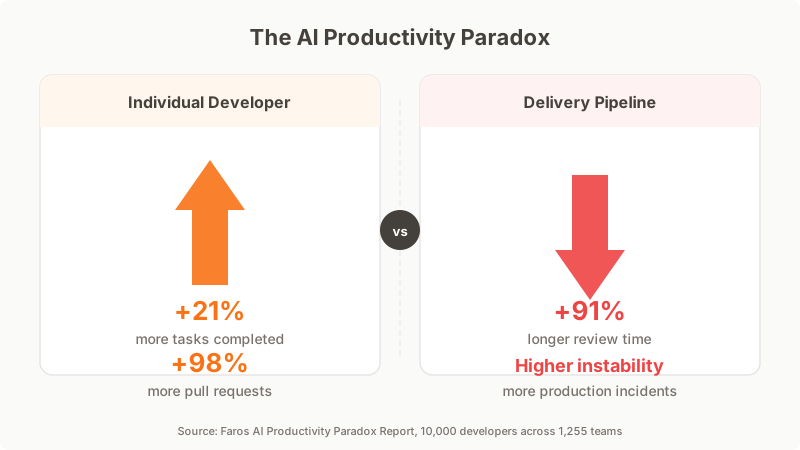
I see the same thing in the Faros AI Productivity Paradox report, which tracked 10,000 developers across 1,255 teams. Developers using AI produce 21% more tasks and 98% more pull requests. But the time spent reviewing pull requests jumped by 91%. It means that the code is coming in faster than anyone can check it.
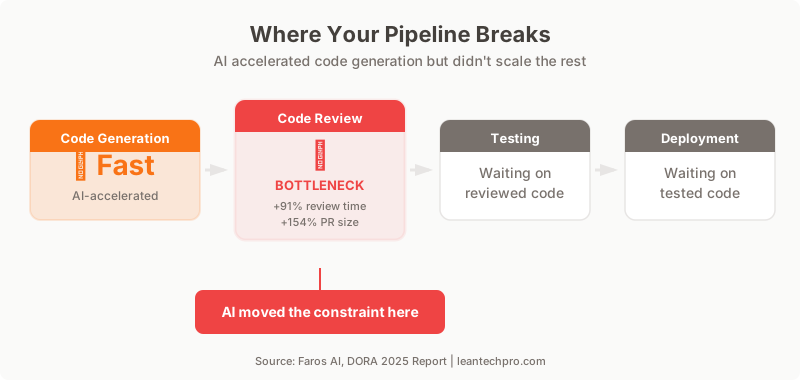
PR size went up 154% on average. But pull requests take longer to review and pose greater risk when merged. They also go against everything we know about small batches and delivery stability.
OpenAI’s own numbers show where this ends. Nearly every engineer there uses Codex and merges 70 percent more pull requests each week. Human review could not absorb that volume, so the agent itself now reviews almost every PR before a person sees it. Even the company that builds the tool had to rebuild its review step around the new speed. Most teams adopted the speed and skipped that part.
AI Creates Five New Forms of Waste
The traditional delivery metrics miss AI-specific waste. Here are five patterns from teams that adopted AI tools without redesigning their workflow.
Rework from hallucinated code. AI generates plausible-looking code that passes initial review. But two sprints later, the team discovers edge cases that the AI didn’t handle. The fix costs more than writing it from scratch would have.
Review bottleneck inflation. Your senior engineers come from reviewing a normal amount of PRs to three times that volume. They can’t keep up, so reviews get rushed, and bugs get through. Nobody thought to add more reviewers or change the way of working.
Duplicate and conflicting tests. AI test case generators can easily generate hundreds of tests. Many overlap. Some even contradict each other. As a result, the test suite’s runtime doubles. The team spends more time maintaining AI-generated tests than the tests actually save.
False confidence in coverage. AI tools report high code coverage numbers. Managers see 90%+ coverage and assume quality improved. But AI-generated tests often cover trivial paths while missing critical business logic. So, coverage went up, and quality didn’t.
Context switching between AI tools. 89% of engineers say jumping between tools disrupts their workflow. Think about it: your team might be running Copilot for code, a separate tool for reviews, another one for tests, and something else for ticket triage. Each one comes with a different interface, and your engineers have to validate the output from all of them.
Why Traditional Metrics Don’t Catch This
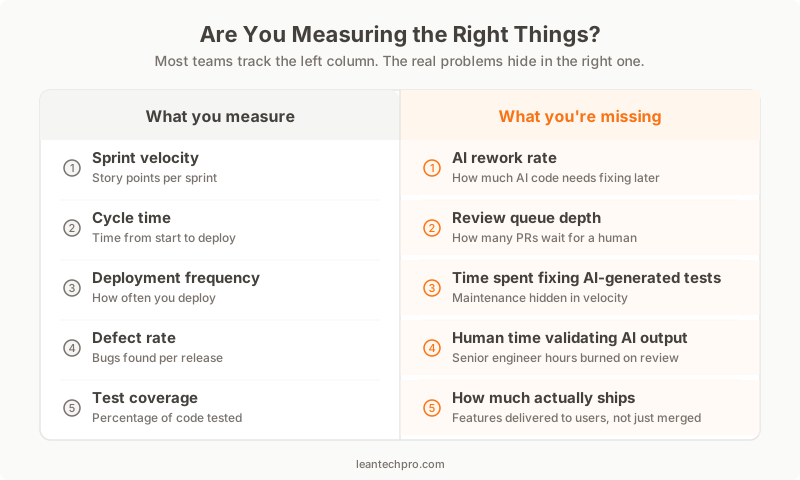
Your sprint velocity looks fine. The deployment frequency might even be up, and the dashboard is green across the board.
The point is that your current metrics were built before AI, and don’t catch what AI breaks.
The velocity measures effort, not outcome. The deployment frequency is how often you ship, not whether you shipped the right thing with acceptable quality. So, these metrics were designed for human-only teams. That is the reason why they don’t capture AI-specific failure modes.
There are also two different clocks, and most dashboards only show one. Cycle time is how fast your team moves an item through its own process. Lead time is how long the customer waits, from request to delivery. AI improves the first clock, most of the time. The customer only feels the second.
I once mapped a request that a team finished in four working days. The customer waited forty-five. The other forty-one days, the request sat in queues. The team’s board was green the entire time.
According to McKinsey, only 39% of organizations report any financial impact from AI at the enterprise level. The rest invested but can’t point to a business result.
The Root Cause Is System Design
Your delivery system was designed for the following process: humans writing code, reviewing, writing tests, and triaging bugs. You added AI to each step but kept the same handoffs, review gates, capacity planning, and metrics.
AI doesn’t replace steps in your delivery pipeline. In fact, it changes the ratio between steps. Code generation got 10x faster. Code review didn’t. Testing capacity didn’t scale. The deployment risk assessment didn’t adapt.
When one part of a system speeds up, and the rest doesn’t, work piles up at the constraint. Your AI investment increased the rate of input into the same bottleneck. The system tells you this through late deliveries, growing review queues, and increasing rework, but only if you know where to look.
What to Fix First
There is no need to rip out your AI tools. You need to redesign the system around them.
Measure AI-specific metrics. Start by tracking rework caused by AI-generated code separately from human-authored rework. Then, measure review queue depth and wait time. Calculate the real cost per AI tool. Compare it to measurable delivery gains.
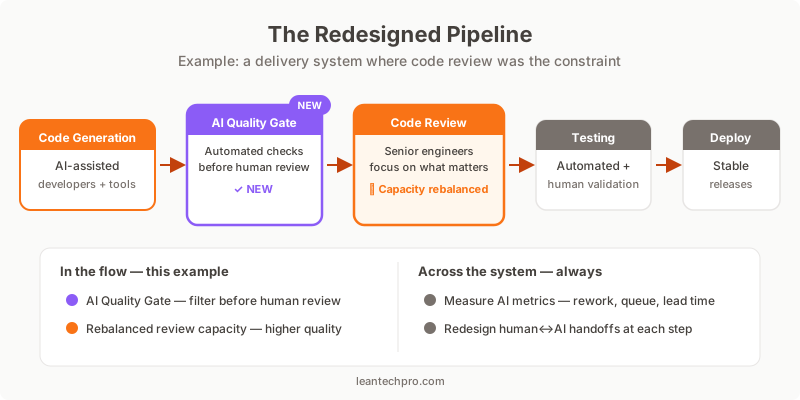
Rebalance capacity at the constraint. If code review is the bottleneck, invest there, whether that means more reviewers, better AI-assisted review tools, or smaller PR size limits that keep batches reviewable.
This rebalancing is now visible at the market level. Anthropic shipped a multi-agent code review tool in March 2026 to check the flood of AI-generated code. HubSpot built Sidekick, a multi-model review agent, after six months of iteration on its own pipeline. Augment’s Intent splits the work across coordinator, implementor, and verifier agents. The pattern is identical everywhere: machines absorb pattern recognition and verification, and the human layer concentrates on judgment, what is needed, what fits, what is worth the cost. The review bottleneck is not being eliminated. It is being clarified down to the part that cannot be automated, and allocating that judgment is a system-design question, not a tooling one.
Set AI output quality gates. Don’t let AI-generated code bypass the standards you’d apply to human code. Define acceptance criteria for AI output that include edge case coverage.
Redesign handoffs for “human + AI” work. Here is where I start when working with a team: map your delivery flow end to end. Identify every point where AI output feeds into a human step. Then, ask: Did we adjust capacity, expectations, and quality checks to accommodate the increased volume?
The AI Delivery Audit
Every CTO I talk to bought AI tools expecting faster delivery. At the time to prove the tools delivered on that promise, difficulties appear. Many can’t even measure it.
The problem is treating AI as a drop-in upgrade when it actually changes how your entire delivery system operates.
If you can’t answer “Are my AI tools making delivery faster or slower?” in 30 seconds with real numbers, you have a measurement gap. And that gap is costing you in delayed releases, wasted AI spend, and frustrated engineering teams.
I built a free scorecard that helps you identify where your delivery system breaks down. Ten questions, for two minutes. You’ll know exactly where to look.
→ Take the Free Delivery Scorecard
→ Download the full diagnostic framework: 7 Questions Every CTO Should Ask About AI and Delivery