Why Engineers Don't Act on Cloud Costs

Why Engineers Don't Act on Cloud Costs

FinOps teams struggle to get engineers to take action. This isn’t new. In a FinOps Foundation survey, 40% of respondents rated this issue as their top challenge. The diagnosis was that engineers are unaware of costs. They feel cost is not their responsibility. In addition, they work in environments where delivery deadlines drive effort. The conclusion was that it is an awareness and motivation problem. In every team I’ve coached so far, I’ve observed the same thing. It is not only about FinOps. Testers, for example, who don’t file clean defects. Or tech who don’t respect a 24-hour SLA. Or even developers who don’t run the required root cause analysis. ...
The Twenty Minutes That Never Came Up

The Twenty Minutes That Never Came Up

Most of what a manager knows about the work arrives through two filters. The dashboard drops everything that never became a number. It records events, and most of a workday happens between them. For example, a ticket moves to “In Progress” at 9 and to “Done” at 16. In those seven hours, the tester spent twenty minutes figuring out which environment was current and waiting while it rebuilt. So the tool records two events, and the day happened between them. ...

Engagement Is a Performance Signal, Not an HR Survey

Engagement Is a Performance Signal, Not an HR Survey

An infrastructure team ran production across four time zones. I was there for the delivery numbers: production incidents, alarm volume, backlog. The delivery board told one story. The team, asked one by one, told another. The NPS was minus 15. The first measurement I brought an instrument I run on my engagements: the Voice of Employees. It takes the same discipline I apply to customers, pointed at the team itself, once at the start of the project and once at the end. I ran it with an internal coach I was training to carry the method. ...

How We Halved DevOps Deployment Lead Time

How We Halved DevOps Deployment Lead Time

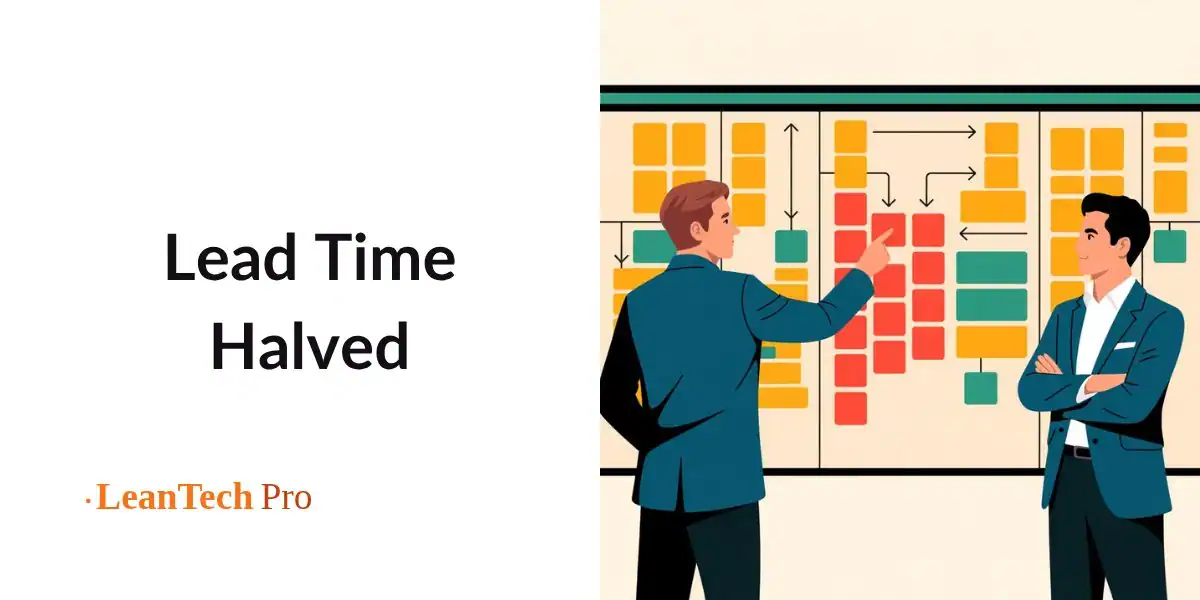
KEY TAKEAWAYS A DevOps team cut its infrastructure deployment lead time by more than half. The team followed Agile practices well. The blockers hid in cross-team handoffs where no ceremony could reach. Value stream mapping revealed about half the lead time lost in a single queue due to unclear routing and missing documentation. Simple interventions drove the result: checklists, front-loaded requests, early handovers. No new tools. No reorganization. The Problem A DevOps team at a large enterprise handled cloud infrastructure deployments. A small DevOps team, working across multiple projects, supported development teams who needed environments to build and test their applications. ...

Engineering Team Performance: A Non-Technical Founder’s Guide

Engineering Team Performance: A Non-Technical Founder’s Guide

KEY TAKEAWAYS If your sprint velocity looks fine but features keep slipping, the problem is invisible to any dashboard you have access to. A non-technical founder can assess engineering health without reading code. You just need to know which signals to look for. The most expensive engineering teams are often the quietest ones. Silence is not a good sign. Not sure your engineering team is performing? Book a free 30-min call. I’ll tell you exactly what to look for. Book a Free Call ...

Your Delivery System Is Part of Your Product

Your Delivery System Is Part of Your Product

KEY TAKEAWAYS The product vs. productivity debate creates a false choice: Delivery capability is not separate from your product—it’s part of what customers buy and experience. Product ≠ offer: A product includes features, delivery system, quality level, and support experience. Toyota never separated “the car” from “how the car is made.” Customers experience your delivery system directly: They pay for speed, uptime, and responsive support. Amazon’s product isn’t “stuff online”, it’s “stuff online, delivered tomorrow.” Speed enables learning, learning finds value: Faster delivery creates faster feedback loops. Teams that ship quickly learn what customers actually want. Slow teams guess. Most teams don’t lack ideas—they lack delivery capability: The bottleneck is rarely “we don’t know what to build.” It’s “we can’t ship what we know we should build.” I keep hearing the same advice: focus on your product, not your productivity. The argument sounds strategic: focus on what matters rather than internal mechanics. Stop rearranging deck chairs. Build something customers want. ...

How to Scale Customer Support Without Just Hiring More People

How to Scale Customer Support Without Just Hiring More People

A Lean approach for startups growing faster than their support team can handle KEY TAKEAWAYS On-time resolution jumped from 40% to 68% by switching from push-based assignment to a pull system where technicians take tickets when they have capacity Escalation rate dropped from 20% to 11% through quality standards and visual management Client satisfaction improved from 7/10 to 8/10 with no additional headcount 44-ticket backlog cleared by making flow visible and enforcing a 24-hour assignment rule Your inbox is a disaster. Tickets are piling up. Your support team is stressed, working late, and still falling behind. Customers are getting angrier. Response times are slipping. ...

When Agile Coaching Doesn’t Deliver: A Results-Based Alternative for Tech Leaders

When Agile Coaching Doesn’t Deliver: A Results-Based Alternative for Tech Leaders

KEY TAKEAWAYS Frameworks organize work, they don’t fix it: 84-96% of Agile transformations fail because they optimize the container (sprints, ceremonies, roles) without addressing how work actually flows through the system. Define outcomes first, then work backward: Results-based coaching starts with a specific, measurable performance gap and identifies the changes that will close it, rather than adopting a methodology and hoping for results. Four practices drive measurable improvement: Performance gap framing, direct observation, value stream mapping, and root cause analysis reveal problems that retrospectives and dashboards miss. Case study proof: A DevOps team running Scrum reduced infrastructure deployment lead time from 64 to 29 days (55%) by tracing actual work across team boundaries and fixing specific root causes. Start this week: Trace one feature end-to-end, spend one hour observing your team work, and define one performance gap with specific metrics. If coaching engagements have disappointed you by promising transformation yet delivering nothing more than process buzzwords, you are not alone. ...

Value Stream Mapping: The Missing Piece in Your ARTs

Value Stream Mapping: The Missing Piece in Your ARTs

KEY TAKEAWAYS Stop Building “Agile Silos”: Rushing to form ARTs around technical specialties reinforces old bottlenecks. Value Stream Mapping re-centers everyone on real customer value. Start with Data-Driven Fixes: Use Value Stream Mapping to quickly pinpoint dependencies and inefficiencies—no major restructures needed. Focus on high-impact workflows for faster, visible wins. Accelerate and Scale: In one claims process, lead time halved from 94 to 45 days and customer satisfaction rose 15%. Quick wins build momentum for lasting change. The Rush to Structure: A Common Transformation Pitfall Organizations embracing Agile at scale often stumble at the first hurdle: setting up their Agile Release Trains (ARTs). The pressure to show quick progress pushes leaders toward the familiar – organizing teams around technical specialties rather than customer value. ...

The ‘Top Priority’ Problem: Why Engineering Teams Struggle With Delivery

The ‘Top Priority’ Problem: Why Engineering Teams Struggle With Delivery

KEY TAKEAWAYS When everything is marked urgent, delivery stalls. Without real prioritization based on capacity, teams drown in work and nothing flows. Good tools and talent can’t fix broken systems. AI and fast coding mean little if reviews, testing, and handoffs stay overloaded or unmanaged. Leaders must design for flow, not push for speed. The real shift comes from limiting WIP, creating pull, and making the delivery system visible and stable. Does Your Team Have the Same Problem? Take the 3-minute Delivery Flow Scorecard to find out: Your team’s flow score (0-100) Whether you’re pushing or pulling work Your #1 hidden bottleneck Find Your Team’s #1 Bottleneck (Free) → ...