
KEY TAKEAWAYS
- A 13-person billing test team increased productivity by 24% in three months by making work visible, setting daily targets, and solving problems one at a time with PDCA.
- Diagnostic before action: observing testers at their workstations revealed hidden waste like seven help requests in three hours, repeated tests without conclusions, and two-hour solo investigations.
- When the project manager changed mid-project, the new manager walked into a team that ran itself. Visual boards, tracked indicators, and clear action plans made the transition seamless.
Get the Lean Testing Quick-Start Kit. 4 practices, real results, a two-week plan to start Monday.
Get the Kit →
Thirteen testers worked across two sites, a main one and a smaller offshore team. They validated billing scenarios before each production release: invoice generation paths and migration batches.
The client had complaints. Tests started too slowly at the beginning of each phase. Nobody could see what was happening with billing tests on a day-to-day basis. The client kept asking for more tester autonomy and felt like he was repeating himself.
Diagnostic Before Action
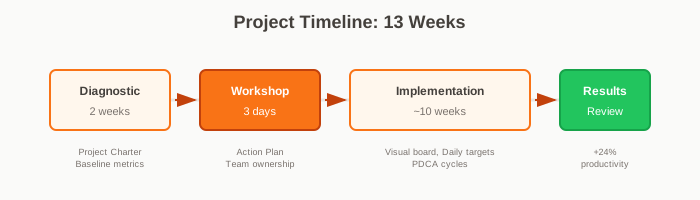
Before starting this Lean Testing transformation, I spent time collecting data and observing the team at work. I interviewed the client, measured current performance, and watched testers at their workstations. This phase produced a report including baseline numbers and targets.
What the Data Showed
Customer satisfaction sat at 6 out of 10. The team validated 0.37 billing scenarios per person per day. And 15% of the defects they reported turned out to be false alarms or got assigned to the wrong team. That last number caused friction among developers and ate up everyone’s time.
The manager saw something else, too. Two or three testers held critical knowledge, and if one got sick during a release, the whole thing could collapse.
What I Saw at the Workstations
One observation session caught a tester asking colleagues for help seven times in three hours. Another showed someone running the same test multiple times, getting the same result each time, but not concluding. A third revealed two-hour investigation sessions before anyone thought to escalate or open a defect.
Technical environment incidents piled up, too. Dozens in a single month, right at the start of a release phase. The billing cycle kept failing with cryptic errors. Nobody had told the testers that an internal project somewhere else had been cancelled, leaving orphan data in the system that broke their test runs.
Testers put in effort, but much of it went into rework, waiting, or solving problems alone that the team could have fixed together in minutes.
Three Days to Build the Action Plan
I brought a few testers into a three-day workshop while the others stayed on production to keep deliveries running. At the end, they presented their findings to their colleagues, so everyone could learn and contribute to the final action plan.
First, I taught them the Voice of Client as a lean technique and how to collect it. I shared the customer satisfaction I collected. They drafted a questionnaire to systematically collect clients’ feedback.
That first day, testers also observed their own process. They watched colleagues execute tests, write defect reports, and handle blockers. They timed activities. They counted interruptions. By the end of the day, they saw problems they had stopped noticing.
I then taught specific Lean techniques matched to what we had found during the diagnostic. Waste identification: spotting rework, waiting, and handoffs that add no value. Quality management: understanding why defects get rejected and how to prevent false reports. Pull flow: setting daily targets backwards from delivery dates. Visual management: making work status visible to everyone at a glance. PDCA: a structured way to solve problems one by one. Performance indicators: measuring what matters daily, not monthly.
Testers applied each technique to their real work during the workshop. They analyzed actual defects from the current release. They mapped their actual test execution flow. They also calculated their actual productivity gaps.
By the third day, the team had built its own action plan. I was acting as a Coach so it was not something I handed them. They had identified what to change, how to measure progress, and who would do what. They presented the plan to their manager, including the rest of the team, and committed to starting immediately.
Visual Board, Daily Targets, Pull Flow
The team started with a visual management board on the wall. It showed every test scenario moving through stages: backlog, design, execution, and done. Anyone walking by could see what was stuck and what was flowing, in real time.
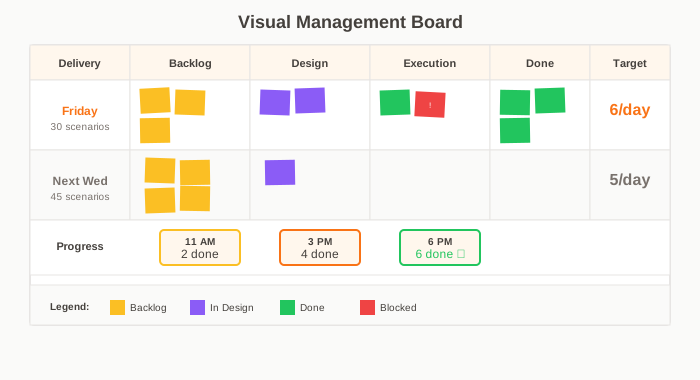
Every morning, the team held a 15-minute flash meeting. They go through: yesterday’s results, today’s targets, and problems blocking progress. The team leader assigned work based on what the board showed, not on assumptions.
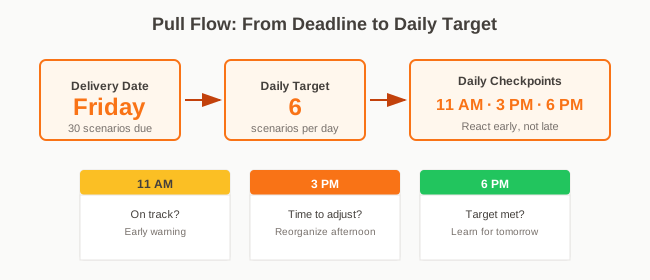
Pull flow tied everything to delivery dates. The team calculated backwards from delivery dates. If 30 scenarios had to be completed by Friday, that would mean 6 per day. They tracked progress daily at 11 AM and 3 PM. If they fell behind by lunch, they reorganized the afternoon. No more discovering on Thursday that Monday’s plan had failed.
A new rule changed behavior: call the team leader immediately when blocked or without work. There were no more two-hour solo investigations. Problems surfaced in minutes instead of days.
Problem-Solving in Action
The visual system exposed problems, a core Lean Testing principle. PDCA gave the team a way to fix them.
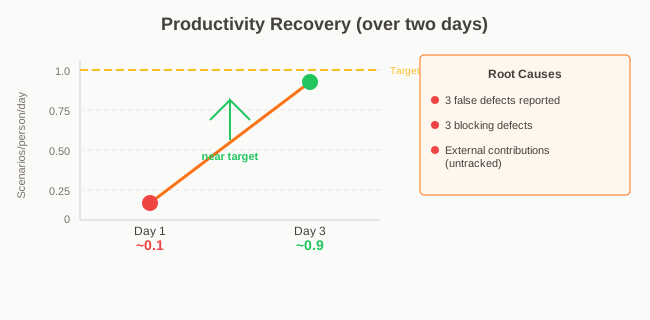
One day mid-release, productivity dropped to about 0.1 scenarios per person per day. The PDCA analysis found three causes. Seven defects had been reported that day, but the pre-diagnosis step rejected three as false. Two testers spent two hours each on that dead end. Three blocking defects left nothing to test. And contribution requests from other projects pulled testers away without anyone tracking them.
The team acted. Testers now called the leader when blocked. External contribution requests got declared at the morning flash meeting. Progress updates happened in real time on the visual board. Two days later, it was back near target, around 0.9.
Another PDCA tackled the billing cycle failures. The root cause: a hundred or so contracts still referenced products from the cancelled project I mentioned earlier. Those products no longer existed in the database, but nobody had cleaned up the test data. The fix took a few table updates. The prevention: add a step to every release asking for the list of cancelled projects and their data impacts.
A third PDCA attacked blocked scenarios. Early in a cycle, around twenty scenarios sat stuck. The causes included migration issues, technical environment problems, and a script that couldn’t handle empty files. Priority conflicts between test cycles. The team worked through each cause, resolved nearly all of them, and documented the patterns to catch earlier next time.
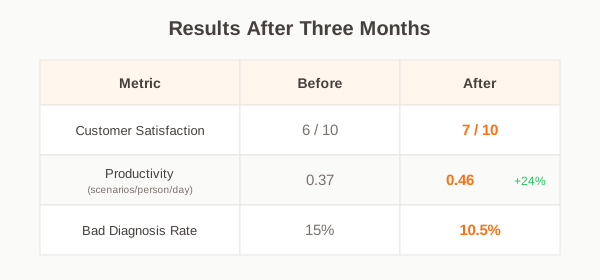
Results After Three Months
Productivity rose from 0.37 to 0.46 scenarios per person per day. That’s a 24% increase with no additional headcount.
The bad diagnosis rate (false defects plus wrong assignments) dropped from 15% to 10.5%. The team set a target to push below 10%.
Customer satisfaction moved from 6 to 7 out of 10. The client noticed changes in how the team communicated, how quickly problems were raised, and how visible progress had become.
Something unexpected happened mid-project. The team’s project manager changed overnight. In most situations, this would cause chaos. Here, the new manager walked in to find a visual board showing exactly what was happening, indicators being tracked, action plans on the wall, and a team that knew how to run itself. The transition happened without drama.
What Made It Work
Three factors made the difference: visible work, team-owned daily targets, and solving problems one at a time.
The work was visible. The board on the wall meant no one could pretend things were fine when they weren’t. Stuck items showed up immediately. The 11 AM check revealed problems, allowing time to fix them and ensure the performance by the end of the day.
The team owned daily targets. The number came from delivery dates, not from a manager’s wishful thinking. Testers calculated it themselves. That ownership mattered.
They solved problems one at a time. The team didn’t try to fix everything in a big process redesign. They picked the problem hurting them most that day, ran a PDCA, fixed it, and moved to the next one. Small wins accumulated into real change.
This is Lean Testing in practice: visible work, team-owned targets, and problems solved one at a time.
The manager visited monthly to see reality firsthand. Lean practitioners call this Genchi Genbutsu. Those visits kept leadership connected to the actual work rather than filtered reports.
Other teams in the shared service center noticed. Colleagues watched the transformation and asked to join the approach. The experiment became a model.
A testing team with a frustrated client found a way to work better. Not by adding tools or people, but by watching their own work, making it visible, and fixing problems as they found them. Lean Testing scales. It starts with observation.
Get the Lean Testing Quick-Start Kit. 4 practices, real results, a two-week plan to start Monday.
Get the Kit →