
KEY TAKEAWAYS
- False defects dropped from 44% to 4% by implementing an andon system where testers call for help before reporting uncertain bugs
- Testing productivity more than tripled (from 1.5 to 8 tests per person per day) through a pull flow system with daily targets
- Failed corrections dropped from 23% to 10% using a quality wall with expert verification
- Client satisfaction recovered after years of complaints, with the client noting clear improvement in service quality
This case study was co-presented with Arnaud Cailleau, then Director of Testing Services at Sopra Steria.
[Download the original presentation (PDF)]
This Lean Testing case study documents one of the sharpest transformations I’ve seen in my career as a Lean coach.
Get the Quick-Start Kit to apply these practices on your team. 4 practices, templates, two-week plan.
The Call
The manager carried a mix of frustration and determination. His testing team, fifteen people strong, had become the bottleneck everyone complained about. The client was not happy. Defects kept slipping through to production. Deadlines felt like a constant threat.
That conversation started one of the sharpest transformations I’ve see in my career as a Lean coach. What happened next surprised me.
The Setting
The team worked for a major IT services company, testing a complex insurance application. That platform handled healthcare claims processing for several mutual insurance companies, calculating reimbursements, managing coverage rules, and processing payments. The kind of software where a single bug could result in thousands of people receiving incorrect reimbursement amounts.
Fifteen testers received software versions from the development team and ensured quality before delivery to the client. On paper, the mission sounded straightforward. In practice, the team struggled with problems they could not see clearly.
The client’s feedback stung: “Too many defects, it’s too important!” They complained about recurring bugs, fixes that broke other things, and a chronic pattern that eroded trust. One recent version contained seven regression defects that had already appeared and supposedly been fixed before. The client’s patience had worn thin.
What I Found
When I first walked into the team’s workspace, tension filled the air. Testers sat isolated at their desks, focused on their screens. No visible indication of who worked on what, which tests ran behind schedule, or where problems lurked.
I spend time observing because it always reveals more than questions do. I watched testers write tests, execute them, and report defects. I measured and listened.
The numbers painted a grim picture. Client satisfaction had dropped to 4.6 out of 10. Productivity stood at 0.7 tests per person per day, far below the workload demand. When I analyzed correction cycles, I discovered that 23% of bug fixes failed on first delivery. The developers would fix something, testers would verify it, declare it working, and then the client would find it still broken. Twenty-three percent of the time.
But one number shocked me more than any other. When I examined defects reported by the testing team to the development team, I found that 44% of them got rejected. Almost half the bugs testers reported turned out not to be bugs at all.
I had never encountered a false defect rate that high.
Digging Into the Root Causes
The false defects problem fascinated me. Why would experienced testers report so many issues that were not real bugs? I analyzed ten rejected defects in detail, and the causes told a story of systemic dysfunction:
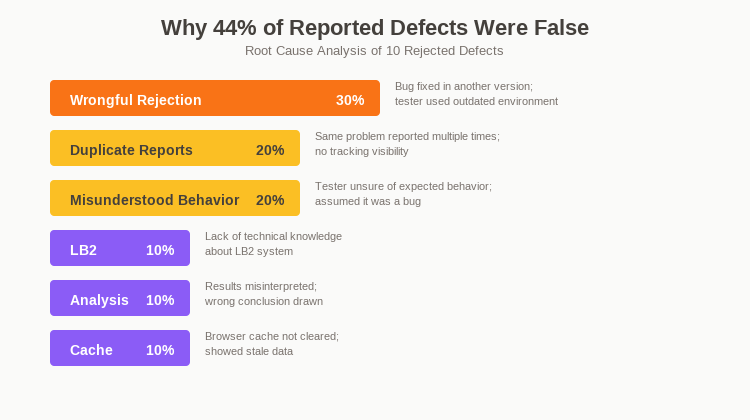
Thirty percent came from wrongful rejections: bugs that actually existed but had already been fixed in a different version. Testers worked on outdated environments without knowing it. Twenty percent were duplicates, the same problem reported multiple times because no one tracked what had already been flagged. Twenty percent stemmed from testers not understanding the application’s expected behavior: they saw something unfamiliar and assumed it was wrong. Ten percent came from a misconfigured Firefox browser that cached old data, making testers believe they saw bugs when they actually saw stale information.
The pattern was clear: testers lacked visibility. They could not see what colleagues had already reported. They did not know when the environments changed. They had no easy way to verify expected behavior before logging a defect. When in doubt, they filed a bug report and moved on.
Good individual practices existed within the team, but no one shared them. Some testers knew tricks others did not. Everyone understood use cases differently. No common vision united their work.
Starting the Transformation
I proposed a Lean Testing approach, built on four principles: support testers directly in the field, foster critical thinking about their own work, establish realistic daily goals, and build new skills systematically. The manager agreed to try it. Half the team showed skepticism. The team leader looked openly doubtful.
We began with a three-day workshop. I taught the testers to observe their own activities with fresh eyes. They learned diagnostic tools: how to identify waste in their processes, analyze their clients’ voices, and trace defects back to root causes.
The exercises forced uncomfortable realizations. Testers saw for themselves how much time they lost searching for information, waiting for environments, and redoing work. They examined the defects the client had reported and mapped out why those bugs had escaped detection. They made observations without ambiguity.
By the end of the workshop, the team had built its own action plan. It was not mine, but theirs. They committed to five changes: build a new working environment, manage the test flow differently, learn problem-solving methods, actively manage quality, and share knowledge systematically.
Making Work Visible
The first thing we built was a visual management system. The team created performance indicators and displayed them on the wall for everyone to see: client satisfaction scores, defect rates, and productivity metrics. No more hiding from reality.
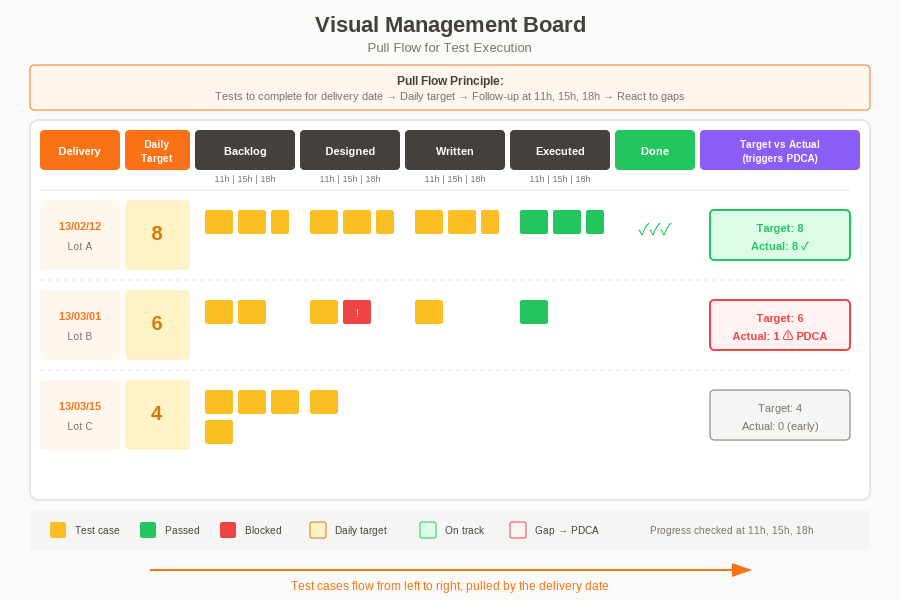
Then came the pull flow board. On a large whiteboard, testers tracked every software lot as it moved through the testing process. Horizontal lines represented different delivery batches. Colored sticky notes showed progress: designed, written, and executed tests. At any moment, anyone walking by could see which lots were running ahead of schedule and which were falling behind.
The key insight came from setting daily objectives. Instead of vague weekly goals, we calculated backward from delivery dates. If a lot needed 100 tests completed by Friday, that meant 20 tests per day. The board tracked actual progress against that target at 11 AM, 3 PM, and the end of the day. When a gap appeared, the objective was 8, the actual was 1, and the team saw it immediately and could react.
This visibility changed everything. Problems that had stayed hidden for weeks now surfaced within hours. The team started holding fifteen-minute daily meetings to share blockers and redistribute work. They began solving problems (PDCA) together instead of struggling alone.
The Andon
For the false defect problem, we implemented a core Lean Testing practice: the andon system. It is a mechanism borrowed from Toyota’s manufacturing lines. The principle: when a tester encountered doubt about whether something was actually a bug, they would not file a report immediately. Instead, they would call the functional expert, who would come to their workstation and examine the situation together.
This was a bigger shift than it sounds. Previously, testers who had questions would either file a defect “just to be safe” or spend long stretches trying to figure things out on their own. Now they had permission (obligation, even) to ask for help before committing to a defect report.
The functional expert went beyond just answering questions. Each interaction became a teaching moment. Twenty minutes with a tester, explaining the expected behavior, showing how to verify it, and transferring knowledge that would prevent the same doubt from arising again.
Within weeks, the false defect rate collapsed. From 44% in April to 8% in May to 4% in June. Testers stopped wasting time writing invalid bug reports. Developers stopped wasting time investigating non-issues. The whole cycle accelerated.
Learning to Solve Problems
The visual management board kept revealing problems: gaps between objectives and actuals, bottlenecks that slowed entire lots, and recurring quality issues.
I taught the team the PDCA cycle, “Plan, Do, Check, Act,” a structured approach to problem-solving. When the board showed a gap, the team leader would initiate a PDCA. Why did we complete only one test when we planned eight? What blocked us? What can we try differently tomorrow?
One PDCA tackled the problem of “corrections KO”: bug fixes that failed verification. The team analyzed recent failures and identified three root causes: test cases that did not cover all scenarios affected by a bug, insufficient documentation of what had actually been tested, and sometimes features disguised as bug reports. They built a quality wall: after testers verified a batch of corrections, a functional expert would perform additional checks specifically designed to catch escapes.
Another PDCA addressed a productivity crash in a specific module. Writing productivity had dropped to zero when it needed to be four tests per day. Investigation revealed that testers were working with an incorrect reference file for reimbursement amounts and lacked knowledge of a dental coverage module required for the tests. The expert provided the correct file, trained the relevant testers on dental coverage, and reviewed their first corrected tests. Productivity recovered immediately.
The Results
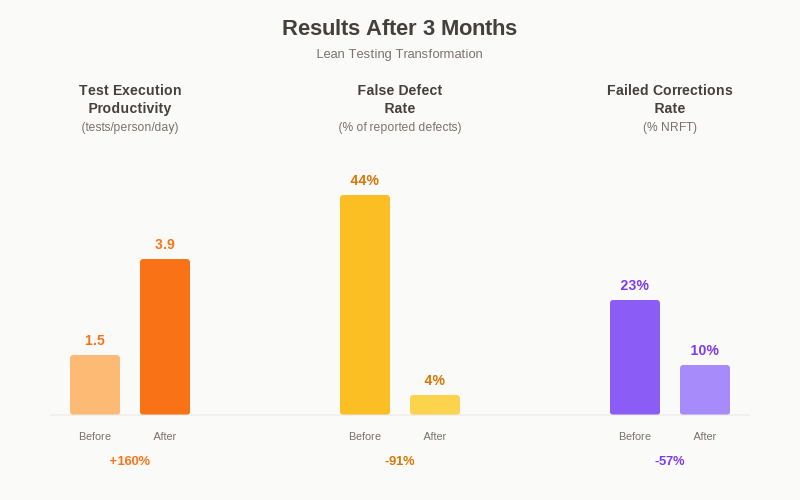
After three months, the numbers told a story that exceeded everyone’s expectations.
Test execution productivity jumped from 1.5 tests per person per day in April to 3.9 in May to 8 in June, more than tripling. Writing productivity doubled. The false defect rate fell from 44% to 4%. The failed corrections rate dropped from 23% to 10% and continued to fall.
The client noticed. After years of complaints, they expressed satisfaction for the first time. They noted a clear improvement in service quality.
The Human Transformation
The manager noticed changes he had not anticipated. Testers who had seemed disengaged now showed genuine motivation for solving problems. The visual management board became a gathering point; people would stop by, look at the status, and discuss what they saw. Conversations shifted from complaints to problem-solving.
New team members onboarded faster. The visual environment gave them immediate context. They could see what their colleagues worked on, understand the flow, and identify who to ask about what. The skeptical team leader became one of the strongest advocates for the new approach.
Team members took ownership of their workspace. They maintained the boards themselves, updated metrics, and initiated problem-solving sessions. The change management happened transparently, driven by the people doing the work rather than imposed from above.
The manager’s own practice changed. Monthly, he visited the team and spent time observing reality firsthand, what the Japanese call genchi gembutsu, “go and see.” These visits gave testers a chance to discuss progress directly with leadership. They created alignment between field realities and strategic goals.
An Unexpected Benefit
Midway through the project, a new project manager joined the team. In normal circumstances, onboarding a manager takes weeks: learning the project status, understanding the dynamics, and figuring out where problems hide.
This time, the new manager understood the situation immediately. The visual boards showed exactly where things stood. The performance indicators revealed the trajectory. The established routines provided structure. Within days, not weeks, the new manager operated effectively. The system had become self-documenting.
What This Project Taught Me
This Lean Testing project taught me practices I now use on every engagement:
Make the work visible. Testing happens inside tools, inside people’s heads. Without visual management tailored to test case flow, problems stay hidden until they become crises. The board we built, “tracking lots through design, writing, and execution,” gave everyone a shared understanding of reality.
Set daily objectives. Weekly or sprint-level goals can lead to problems compounding. Daily targets create daily feedback loops. When you know by 11 AM that you are falling behind, you can still recover. When you discover it on Friday, you cannot.
Build an andon culture. Giving people permission to ask for help “requiring it, even,” transforms quality. The false defect problem vanished because they stopped guessing on their own.
Teach problem-solving, not just solutions. Every PDCA the team completed built capability. They learned to diagnose root causes, test countermeasures, and verify results. Those skills outlast any specific fix.
Invest in knowledge transfer. Twenty minutes per day, one-on-one with a tester, teaching specific skills; this investment compounds. Good practices spread, variability decreases, and the team grows stronger.
You just saw the results. Now start your own.
Get the Lean Testing Quick-Start Kit: the 4 practices from this case study, a visual board template, and a two-week action plan.