
KEY TAKEAWAYS
- AI-assisted “vibe coding” has increased code duplication 8x while decreasing refactoring by 40% in 2024, significantly accelerating technical debt (GitClear’s analysis of 211M code lines).
- Four technical debt accelerators: “Good Enough” solutions lacking architectural fit, AI’s limited context window creating architectural blindness, duplicated similar solutions, and code growing beyond developer comprehension.
- Lean Tech implementation strategies: Early validation against real use cases, shortened feedback loops, continuous improvement of AI tools/prompts, and active waste reduction through code simplification.
“Vibe coding” burst onto the tech scene when Andrej Karpathy, former Tesla AI director and OpenAI co-founder, coined the term in February 2025. He described it as “fully giving in to the vibes, embracing exponentials, and forgetting that the code even exists.” This new coding approach leverages advanced AI assistants like Cursor Composer to generate code with minimal human oversight. Developers speak commands, accept AI suggestions without review, and troubleshoot by returning error messages to the AI. The code grows beyond the programmer’s comprehension yet somehow functions—at least for weekend projects.
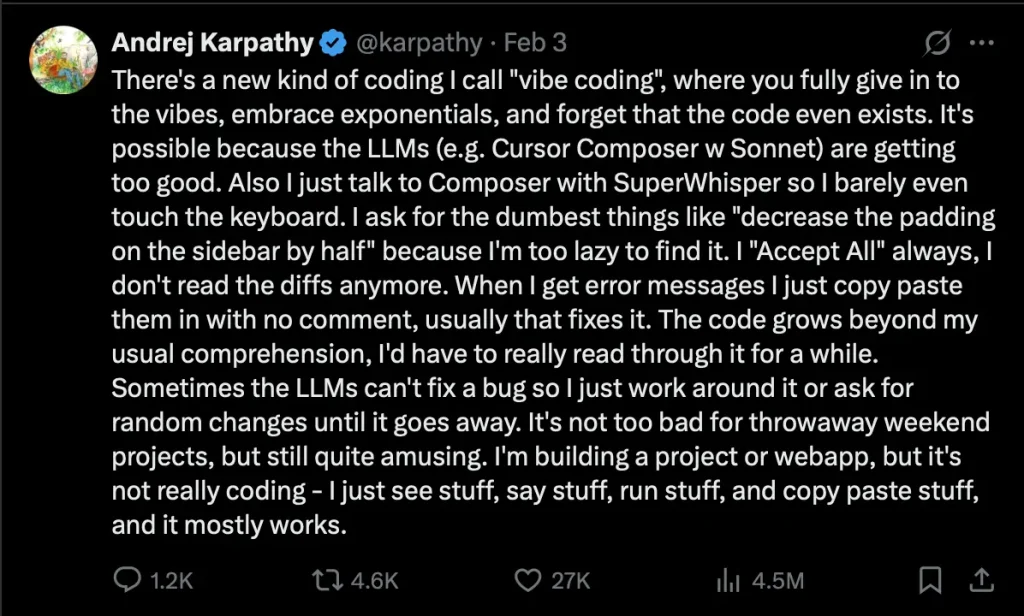
What started as Karpathy’s amusing observation quickly revealed a deeper industry-wide trend. Recent research from GitClear confirms this shift. Their analysis of 211 million lines of code shows alarming patterns: code duplication increased eightfold in 2024 while refactoring dropped by nearly 40%. We’re witnessing a fundamental transformation in how software gets built.
This transformation creates a troubling paradox. We write more code faster than ever, but that speed comes with hidden costs. When developers surrender understanding and oversight to AI tools, they’re not just coding differently but might accelerate technical debt. Each unexamined code suggestion, each duplicated block, and each skipped refactoring opportunity compounds silently over time.
Lean Tech principles offer a promising counterbalance to this troubling trend. By applying lean thinking to AI-assisted development, teams can harness AI’s productivity benefits without sacrificing code quality. This article explores how the “vibe coding” phenomenon creates technical debt and presents strategies to keep AI-driven development lean, sustainable, and built for long-term success.
The GitClear Research and What It Reveals
The numbers tell a stark story. GitClear’s comprehensive study analyzed 211 million lines of code across both commercial and open-source projects during 2024, revealing three troubling trends:
- Code duplication exploded. Blocks with five or more duplicated lines increased 8 times compared to previous years. It means developers now paste the same code across multiple locations rather than creating reusable functions.
- Refactoring plummeted. The research documented a 39.9% decrease in moved lines of code, a key indicator of refactoring activity. For the first time in software development history, copy/pasted lines exceeded moved lines.
- Code volume surged. The total amount of new code added to repositories grew exponentially, suggesting quantity now trumps quality in many development environments.
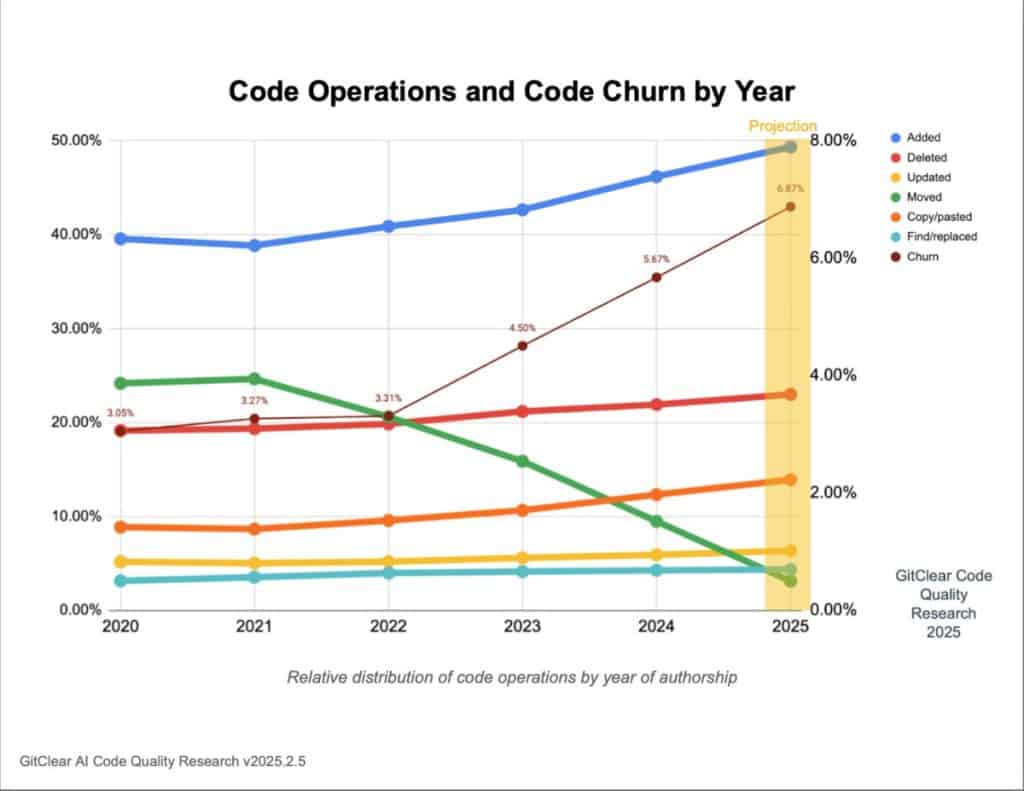
These findings contradict the rosy picture painted by Google’s 2024 DORA “State of DevOps” report, which claimed AI adoption improved code quality by 3.4%. However, even Google’s researchers acknowledged a critical caveat: delivery stability dropped by 7.2%. When we dig deeper, both reports highlight the same phenomenon from different angles.
The culprit? According to GitClear, AI coding assistants make inserting new code blocks effortlessly: press the tab key. These tools excel at generating fresh code but struggle to suggest reusing existing functions elsewhere in the codebase. This limitation stems partly from their restricted context window, preventing them from “seeing” the entire codebase as a cohesive system.
This situation creates a fundamental misalignment. Individual code blocks might look clean and efficient when viewed in isolation. But zoom out to the system level, and the picture changes dramatically. The codebase becomes bloated with redundancies, lacks consistent structure, and grows increasingly fragile.
The most concerning finding lies in what’s missing rather than what’s added. AI assistants rarely propose consolidating similar functions or restructuring code for maintainability. GitClear’s researchers emphasize that humans still hold a crucial advantage over AI: recognizing patterns across dispersed code and consolidating them into reusable modules.
Without this human oversight, we risk building software that functions today but becomes unmaintainable tomorrow.
How Vibe Coding Accelerates Technical Debt
Vibe coding transforms how code gets written. Unlike traditional development, where programmers carefully craft solutions with a deep understanding of their systems, vibe coding encourages a detached, almost carefree approach. Developers speak commands, accept AI suggestions without scrutiny, and troubleshoot by feeding error messages back to the AI without genuinely understanding what went wrong.
This shift creates perfect conditions for technical debt to flourish in four specific ways:
- The “Good Enough” Problem. AI tools excel at generating code that appears functional on the surface. The code runs, passes basic tests, and works. This situation creates a false sense of security. Developers accept solutions without questioning their architectural fit, long-term maintainability, or hidden edge cases. Technical debt accumulates beneath this veneer of functionality.
- Architectural Blindness. AI assistants lack system-wide understanding. They generate solutions within their limited context window, typically seeing only a few hundred lines of surrounding code, not the entire codebase. This myopia leads to solutions that solve immediate problems while ignoring broader architectural patterns. As a result, we see inconsistent approaches to similar issues scattered throughout the codebase.
- The Copy-Paste Cascade. When faced with similar problems, AI tools tend to generate similar but slightly different solutions rather than identifying opportunities for abstraction. This multiplication of nearly identical code makes future changes exponentially more difficult. Change one implementation, and you must hunt down and update all its duplicates, assuming you even remember they exist.
- The Comprehension Gap. Karpathy admits that vibe-coded projects quickly “grow beyond usual comprehension.” When developers don’t fully understand their code, they can’t effectively maintain it. It creates a dangerous cycle: less understanding leads to more reliance on AI for modifications, further reducing comprehension.
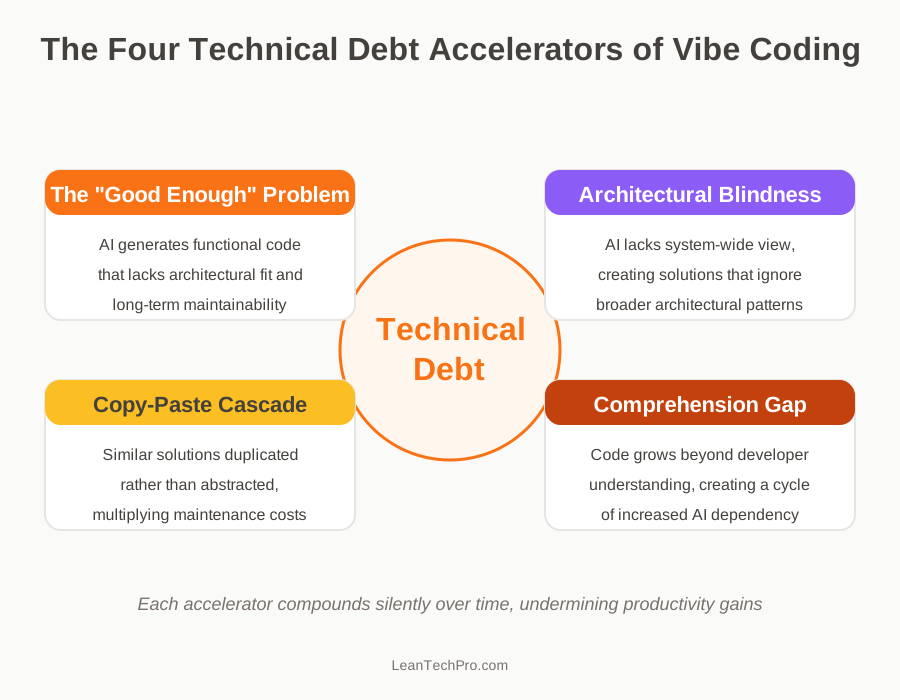
These issues compound rapidly in team environments. Different developers using different AI assistants with varying styles of prompting produce wildly inconsistent code. Without strong standards and review processes, codebases become fragmented patchwork rather than cohesive systems.
We should not underestimate the psychological impact either. Vibe coding subtly shifts developer incentives from quality to speed. It rewards quick, flashy feature delivery while obscuring the long-term costs. Developers celebrate immediate productivity gains without seeing the maintenance nightmare they create for their future selves.
I do not mean AI tools are inherently harmful. The problem lies in how we use them. When we surrender too much control and oversight to AI, meaning entirely “give in to the vibes” as Karpathy puts it, we amplify technical debt’s most dangerous aspects. We create invisible risks that compound quietly over time, eventually undermining the very speed advantages that made vibe coding appealing in the first place.
The Lean Tech Philosophy
Lean Tech offers a powerful counterbalance to vibe coding’s shortcomings. This approach adapts traditional lean manufacturing principles to software development, focusing on sustainable value delivery. It’s not about rejecting AI tools. It’s about using them more intelligently.
At its core, Lean Tech embraces five fundamental principles:
- Value over volume. Lean focuses on delivering what customers truly need rather than maximizing lines of code. This direct challenge to vibe coding’s “more is better” mentality emphasizes that working software doesn’t automatically equal valuable software.
- Flow optimization. Lean teams create smooth, predictable delivery systems where work moves efficiently from concept to customer. They actively identify and eliminate bottlenecks caused by quality issues, knowledge gaps, or process waste.
- Continuous improvement. Unlike vibe coding’s “set it and forget it” approach, Lean Tech demands ongoing refinement. Teams regularly examine their processes, tools, and outputs to find opportunities for enhancement.
- Pull-based systems. Work starts only when there’s a genuine customer need, not simply because AI makes code generation easy. This approach prevents the creation of unnecessary features that bloat codebases.
- Quality built-in. Quality isn’t something added later through testing. We design it into the process from the beginning. This principle directly counters vibe coding’s tendency to defer quality concerns.
Its focus on sustainability makes Lean Tech particularly effective against technical debt. While vibe coding optimizes for today’s productivity, Lean optimizes for long-term delivery capability. It recognizes that today’s shortcuts become tomorrow’s roadblocks.
Lean Tech also reframes how we measure success. Instead of tracking output metrics like lines of code or features delivered, it emphasizes outcome metrics like customer satisfaction, system stability, and team agility. These measures naturally discourage the accumulation of technical debt.
The philosophy reshapes team dynamics, too. Rather than isolating developers with their individual AI assistants, Lean promotes collaborative practices like pair programming, collective code ownership, and regular knowledge sharing. These practices create multiple layers of defense against the architectural blindness endemic to vibe coding.
Most importantly, Lean Tech restores human judgment to its rightful place in software development. AI becomes a tool wielded with intention rather than a replacement for thoughtful decision-making. Developers maintain agency and understanding while still benefiting from AI’s capabilities.
This approach doesn’t mean sacrificing speed. It means redefining it. As the saying goes, “Speed without quality is just faster failure.” True speed isn’t about how quickly you can write code today but how quickly you can deliver value consistently over time. By addressing the root causes of technical debt, Lean Tech enables greater sustainable speed than vibe coding could ever achieve.
Strategies for Lean AI-Driven Development
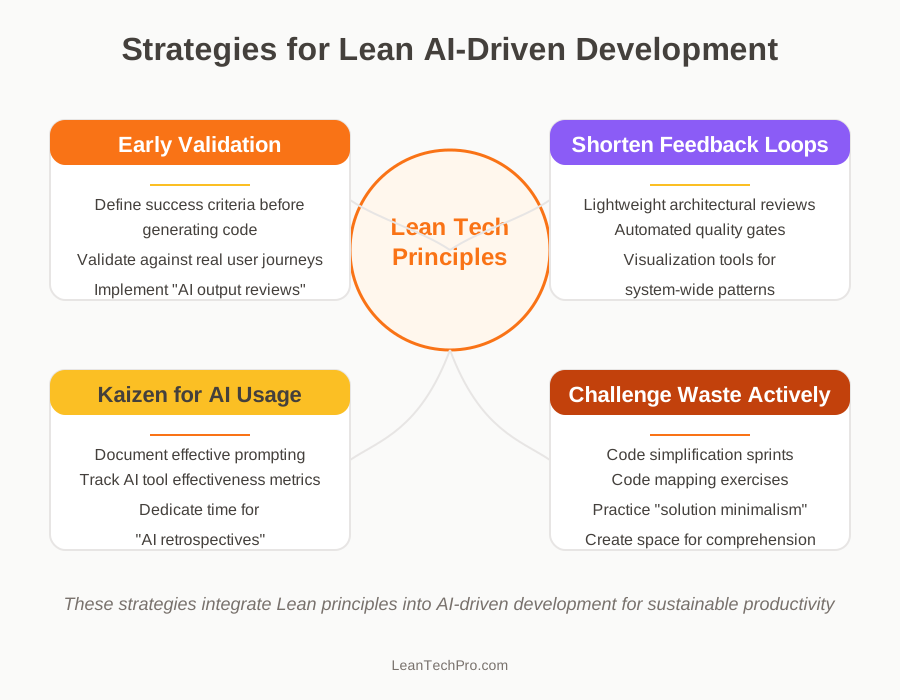
Implementing Lean Tech principles with AI tools requires specific, actionable strategies. Here are four powerful approaches to harnessing AI’s benefits while preventing technical debt:
Early Validation Against Real Use Cases
Move beyond simple, functional testing. AI excels at generating code that runs but struggles to evaluate how well it solves actual user problems.
Start by clearly defining success criteria before asking AI to generate any code. Create scenarios that represent real user journeys, not just technical requirements. Then, validate AI-generated solutions against these scenarios immediately.
Implement structured “AI output reviews” where team members evaluate generated code for functionality and alignment with system architecture, performance requirements, and maintainability standards.
This early validation catches misalignments before they become embedded in your codebase. It shifts focus from “Does it work?” to “Does it work right?”
Shorten Feedback Loops
Traditional code reviews often come too late after developers have invested emotionally in their solutions. With AI-generated code, shorter feedback cycles become essential.
Implement lightweight architectural reviews that happen before committing code. These quick sessions focus exclusively on design patterns, not implementation details.
Use automated quality gates that flag potential issues like duplicated code, excessive complexity, or inconsistent patterns. These gates should trigger immediate conversations rather than just blocking progress.
Create visualization tools that show developers the broader impact of their changes. These tools help bridge the comprehension gap by making system-wide patterns visible.
Shortened feedback loops transform technical debt from an invisible accumulation into a visible concern that teams address continuously.
Embrace Kaizen for AI Usage
AI tools themselves need continuous improvement to serve Lean goals.
Document effective prompting patterns that produce maintainable code. Create team-specific prompt libraries incorporating your architecture standards, naming conventions, and preferred patterns.
Teams should track AI tool effectiveness metrics beyond simple productivity. Measure how often AI-generated code requires rework, creates duplication, or introduces unexpected side effects.
Dedicate time for “AI retrospectives,” where teams discuss their experiences with various tools and techniques. These sessions help teams learn collectively rather than struggling individually.
By applying Kaizen principles to AI usage, teams continuously refine their engagement with these tools to support long-term quality.
Challenge Waste Actively
Vibe coding normalizes waste in the form of duplicated code, unused features, and overly complex solutions. Lean Tech actively challenges this waste.
Schedule regular “code simplification sprints” where teams focus exclusively on reducing complexity without changing functionality. These designated periods make refactoring a priority rather than an afterthought.
Implement “code mapping” exercises where teams visualize duplicate functionality across the codebase. These sessions make invisible waste visible and create opportunities for consolidation.
Practice “solution minimalism” by challenging every AI-generated solution: “Is this the simplest way to solve this problem?” This mindset counteracts AI’s tendency to generate unnecessarily complex solutions.
Create space for developers to understand code before modifying it. It might seem inefficient initially, but it prevents the compounding comprehension gap that accelerates technical debt.
These strategies don’t reject AI tools. They harness them more effectively. By integrating Lean principles into how teams use AI, organizations can maintain code quality and architectural integrity while benefiting from increased productivity.
Implementing a Lean Tech Culture with AI
Adopting Lean Tech principles requires more than individual strategies. It demands cultural transformation. This shift starts with leadership and extends through team structures, metrics, and skill development.
Start by establishing clear leadership expectations:
- Set balanced priorities. Leaders must explicitly value sustainable delivery alongside speed. When executives celebrate only rapid feature delivery, teams inevitably cut corners. Instead, recognize and reward architectural improvements, refactoring efforts, and technical debt reduction.
- Model systems thinking. Leaders should regularly ask questions about long-term impacts, not just immediate outcomes. Simple inquiries like “How will this approach scale?” or “What happens when we need to modify this in six months?” reinforce the importance of sustainable solutions.
- Remove pressure to vibe code. Many teams turn to vibe coding because of unrealistic deadlines. Leaders must set achievable timelines that allow for quality practices and provide air cover when teams push back against unsustainable expectations.
Next, implement team structures that counterbalance AI’s limitations:
- Formalize the architect’s role. Designate experienced developers to maintain architectural oversight across multiple teams. These architects should receive AI-specific training to spot patterns of AI-generated technical debt.
- Create balanced teams. Mix AI enthusiasts with architectural thinkers on each team. This diversity prevents echo chambers where vibe coding techniques go unchallenged.
- Establish code stewardship. Assign specific developers responsibility for maintaining quality in different parts of the codebase. This ownership creates accountability for long-term maintainability.
Transform your metrics to promote sustainability:
- Track technical debt indicators. Monitor duplication rates, code churn, and refactoring activity, the same metrics GitClear used in their research. Make these visible to all teams through dashboards.
- Measure mean time to change. How long does implementing a typical feature or fixing a bug take? This metric captures the real impact of technical debt on team agility.
- Implement architectural fitness functions. Create automated tests that verify adherence to architectural principles. These provide immediate feedback when AI-generated code violates system constraints.
Finally, develop new skills that complement AI capabilities:
- Teach effective prompting. Help developers craft prompts that generate maintainable, aligned code. This skill becomes increasingly valuable as AI tools evolve.
- Build pattern recognition. Train developers to identify reuse opportunities across disparate parts of the codebase, a skill AI assistants still lack.
- Develop critical evaluation. Help teams assess AI output critically rather than accepting it unquestioningly. It includes questioning assumptions, spotting edge cases, and evaluating architectural fit.
The most successful organizations will treat AI as a team member with specific strengths and weaknesses. They’ll delegate tasks that AI handles well, like generating initial implementations or boilerplate code while maintaining human oversight for architectural decisions and system-wide coherence.
This culture shift doesn’t happen overnight. Start with small experiments, celebrate early successes, and gradually expand practices that work. The goal isn’t perfection but continuous improvement, which is the essence of Lean thinking.
Conclusion
The rise of vibe coding represents a pivotal moment in software development. AI-powered coding tools have unleashed unprecedented productivity, but as GitClear’s research clearly shows, this rapid pace comes with hidden costs. The explosion of duplicated code and dramatic decline in refactoring signal a troubling trend toward codebases that function today but become maintenance nightmares tomorrow.
Lean Tech principles offer a powerful way forward. By focusing on value over volume, building quality into our processes, and embracing continuous improvement, teams can harness AI’s benefits while avoiding pitfalls. The four key strategies – early validation, shortened feedback loops, continuous AI improvement, and active waste reduction – provide a practical framework for responsible AI adoption.
This approach doesn’t reject AI’s capabilities. Instead, it integrates these powerful tools into a more thoughtful development process. Developers maintain oversight and understanding while leveraging AI to handle repetitive tasks, generate initial implementations, and augment human creativity.
The teams that thrive in this new era won’t be those who code at maximum speed. Success will come to organizations that balance immediate productivity with long-term sustainability: teams that use AI as a powerful tool rather than surrendering control to it.
One truth remains constant as we navigate this transformation: great software ultimately comes from human insight, discipline, and care. AI can amplify these qualities, but it can’t replace them. By applying Lean Tech principles to AI-driven development, we can build systems that deliver value consistently over time, creating not just code that works but code worth working with.
Implementing Lean Tech in the rising context of vibe coding isn’t just about software quality. It’s about whether we’ll control our tools or be controlled by them. By making this choice consciously, we shape our codebases and the future of our profession.
Frequently Asked Questions
What is the first practical step for implementing Lean Tech in AI-driven development?
Start by implementing structured “AI output reviews” in your team. During these reviews, team members should evaluate generated code beyond basic functionality. They must check for architectural alignment, assess maintainability, and verify adherence to system patterns. This approach creates an immediate quality checkpoint before AI-generated code enters your codebase. It also helps teams develop a critical eye for evaluating AI outputs.
How can we measure improvements in technical debt reduction when using AI tools?
Track specific metrics like duplication rates, refactoring activity, and mean time to implement changes. Additionally, monitor how frequently unexpected bugs appear in AI-generated code. Track how often teams need to rework AI solutions after implementation. These measurements provide tangible evidence of improvement. They also help make the invisible costs of technical debt visible to stakeholders.
What are common challenges when implementing Lean Tech principles with AI assistants?
The most common challenges include several key issues. Teams must balance speed expectations with quality requirements. They must overcome the initial productivity dip as members learn to use AI more deliberately. Organizations must shift mindsets from “AI as a replacement” to “AI as a tool.” Finally, developers must maintain system-wide understanding as codebases grow. Teams often struggle to resist accepting AI-generated solutions without proper evaluation.
How can smaller teams with limited resources apply Lean Tech strategies?
Smaller teams can focus on lightweight implementations. Use simple visualization tools to map code relationships. Implement micro-reviews for AI-generated code. Create a shared prompt library of effective patterns. Dedicate even just 1-2 hours per week to code simplification. The advantage for smaller teams is greater visibility across the entire codebase, making it easier to spot duplication and inconsistency patterns.
What’s the role of technical leadership in supporting Lean Tech practices?
Technical leaders must model the behaviors they want to see. It includes questioning AI outputs, validating solutions against user needs, and valuing sustainability alongside speed. Leaders should create safe spaces for teams to push back against unrealistic timelines. They need to recognize and reward refactoring and technical debt reduction efforts. Leaders must also help establish clear architectural guidelines for AI tool usage. Most importantly, they must consistently demonstrate that quality matters, even when it’s temporarily slower.
How might a Lean Tech approach differ for front-end versus backend development with AI?
For front-end development, Lean Tech emphasizes consistency in user experience, component reusability, and performance optimization. Teams should implement visual regression testing for AI-generated UI code. They must validate against accessibility standards. For backend development, the focus shifts to service boundaries, data consistency, and system scalability. The principles remain the same in both cases: early validation, shortened feedback loops, and active waste reduction. However, the implementation techniques and specific quality gates will differ.
Is it possible to quantify the ROI of implementing Lean Tech principles with AI tools?
Yes, though it requires tracking both short and long-term metrics. In the short term, you might see a slight decrease in raw productivity. It happens as teams implement more rigorous evaluation processes.
However, long-term measurements typically will show significant improvements. Teams will experience reduced bug rates and faster onboarding of new team members.
The most compelling ROI will appear several months after implementation. At this point, teams can deliver new features more consistently. They also avoid unexpected delays from technical debt.
How do we balance leveraging AI’s capabilities while maintaining code quality?
Create clear boundaries for AI usage. Designate areas where AI can operate with minimal oversight, such as generating boilerplate, test cases, or documentation. Identify areas requiring human review, including architectural decisions, security-critical code, or complex business logic.
Develop team-specific prompting guidelines. These should incorporate your architectural standards and quality expectations.
Finally, implement automated quality gates. These should flag potential issues in AI-generated code for human review. At the same time, they should allow straightforward implementations to flow through.