
KEY TAKEAWAYS
- Lean Testing makes testing problems visible so teams can solve them at the root, instead of hiding waste behind status reports.
- One team cut false defects from 44% to 4% and nearly tripled productivity by using visual boards, andon signals, and PDCA.
- Teams that practice Lean Testing are ready for AI. Teams that don’t will automate their waste instead of removing it.
Get the Lean Testing Quick-Start Kit. 4 practices, real results, a two-week plan to start Monday.
Get the Kit →
Lean Testing applies Lean management principles to software testing. It focuses on eliminating waste, making problems visible, and building people’s capabilities to solve them. The goal is smarter testing that delivers more value with less friction.
This guide covers everything you need to know: the principles, how it works in practice, a real transformation story, and how Lean Testing connects to the emerging world of AI-powered testing.
The Core Idea
Lean Testing is Lean Management applied to software testing teams.
Lean Management builds people’s capability to see and solve problems. It makes work visible, not for tracking, but for learning. When people can see what’s happening, they can identify what’s wrong and fix it at the root, so waste disappears as a consequence.
Software testing teams face challenges that rarely make it into status reports. Priorities shift mid-sprint. Test environments are broken or unavailable. Requirements are unclear, incomplete, or arrive late. Testers discover defects that developers close as “works as designed.” Automation scripts fail for reasons unrelated to the application. Knowledge lives in one person’s head, and that person is on vacation.
You know the symptoms. Testers wait: for environments, for clarifications, for builds, for fixes, for approvals. They report bugs that get rejected. They retest corrections that fail again. They spend hours investigating on their own before asking for help. They context-switch between projects, losing focus. They feel the pressure but can’t pinpoint where the time goes. They deliver on time, but only by cutting corners that no one talks about.
Lean Testing starts by making these problems visible. It gives testers a way to see what’s blocking them, surface issues early, and solve them together. The team develops its own capability to improve rather than following a new process imposed from above by learning to see its work differently.
The results speak for themselves: teams that test smarter, solve their own problems, and waste less time on work that adds no value. For IT services companies, this translates into a strategic advantage: delivering the quality the client expects at the pace they require, while developing people who can solve problems — that becomes a market differentiator.
Why Lean Testing Matters
For Tech Leaders
Classic approaches are running out of steam. Process reviews, audits, knowledge bases, offshoring, none of these help teams evolve as fast as clients demand. Meanwhile, pressure to reduce costs never stops, and Excel reports no longer provide the visibility you need.
Lean Testing offers something different: concrete visibility on what’s actually happening, teams that can handle demand fluctuations, and a way to reduce costs by eliminating waste rather than cutting corners.
For Testers
Testing is often perceived as repetitive, with no clear path forward. Many testers are looking for meaning: a way to grow, to stay employable, to bring more value than just executing scripts.
Lean Testing changes the role. Testers learn to identify problems, solve them, and drive continuous improvement within their organization. They understand client challenges and contribute to solutions. The job becomes a path to growth, not a dead end.
The Principles of Lean Testing
These principles emerged from a Lean transformation I led with a software testing team in 2014. The results surprised us: false defects dropped from 44% to 4%, productivity nearly tripled, and client satisfaction jumped from 6 to 8 out of 10. Since then, I’ve applied and refined this approach with other teams. What follows is what I’ve learned, the patterns I’ve observed, tested, and seen work. As more teams adopt Lean Testing, these principles will continue to sharpen.
1. Make the Flow Visible (Value Stream & Flow)
Test cases follow a flow: design, write, execute, done. That flow may come from any work organization you use. Make it visible. Track test case production daily.
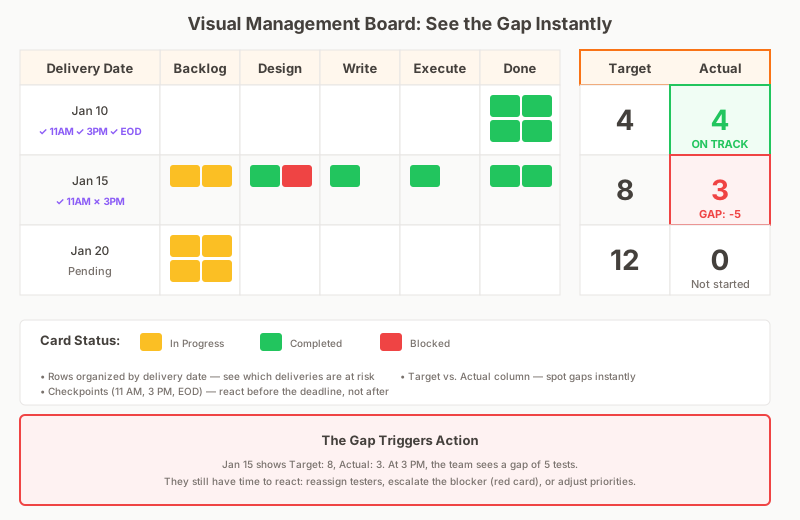
One team tracked progress at 11 AM, 3 PM, and the end of the day. A simple board showed how many test cases were designed, written, and executed against the daily target. When execution lagged behind at 3 PM, the team reorganized priorities before the day ended, but not after the deadline passed.
When flow is visible, bottlenecks reveal themselves. Blocked work isn’t hidden in a spreadsheet; it’s a red card everyone can see.
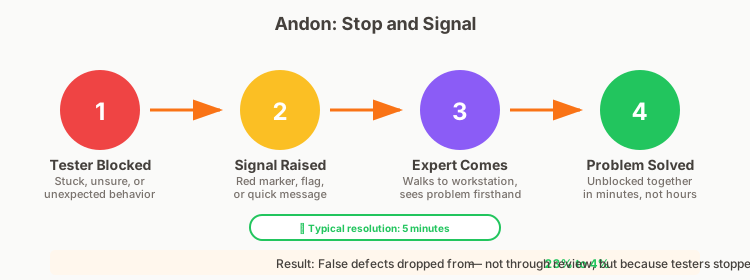
2. Stop and Signal (Andon)
When a tester hits a wall (blocked, stuck, or unsure), he does not waste time guessing. He raises a signal. Immediately, a functional expert comes to help, and they solve the problem together.
One team noticed testers struggling alone for hours before asking for help. They introduced a simple rule: when in doubt, call the expert. The expert comes to the tester’s workstation, sees the problem firsthand, and unblocks the situation on the spot. False defect reports dropped from 23% to 4% not through review, but because testers stopped guessing.
The andon also reveals learning opportunities. Each time the expert responds, they observe the tester’s gestures: how they investigate, interpret results, and report defects. Patterns emerge. The expert then plans short, focused training sessions called “Dojo” — 20 minutes on a specific topic. It could be a functional aspect of the application under test, or a testing gesture, like how to write a clear defect report. The andon becomes a feedback loop: signal, unblock, observe, teach.
The andon system comes from Toyota’s production lines, where workers pull a cord to stop the line when they spot a defect. In testing, the “cord” is a visible signal: a sticky note, a flag on the board, or a quick message. The response is immediate: an expert joins the tester to unblock the situation. The problem gets fixed before it compounds.
3. Build quality into the gesture (Built-in Quality)
Built-in quality means designing the work so that doing it right is the natural path. Instead of being a separate step, the quality check is embedded in the gesture itself.
In testing, a “gesture” is any repeatable action: writing a test case, executing a test, or reporting a defect. Each gesture can either invite errors or prevent them, depending on how it’s designed.
Consider defect reporting. Without a standard, a tester sees unexpected behavior, types a quick description, and submits. Later, the developer rejects it as “cannot reproduce” or “works as designed.” Time wasted on both sides.
Now let’s redesign the gesture. Every defect report requires a screenshot, steps to reproduce, and expected vs. actual behavior with a spec reference. No screenshot, no submission. The tester can no longer report on impulse. To fill in expected behavior, they check the spec and sometimes discover the behavior is correct. The quality check becomes invisible. It’s just part of how defects get reported.
Built-in quality is about making mistakes harder to make.
4. Pull from the Delivery Date (Pull)
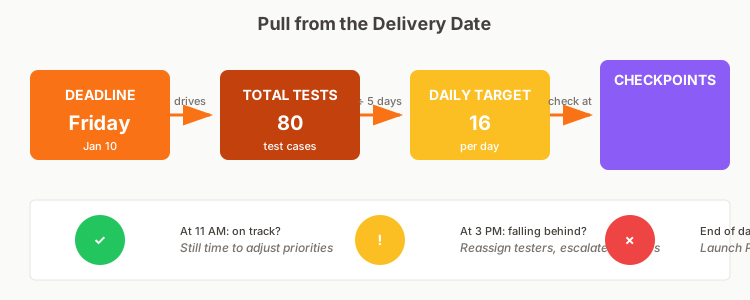
Don’t push tests through the system and hope you finish on time. Pull from the deadline. If 80 tests are due Friday, that’s 16 per day. Now you have a daily target to hit, and gaps surface early, when there’s still time to react.
One team checked progress three times a day: at 11 AM, 3 PM, and the end of the day. At 11 AM, they knew if the morning was on track. At 3 PM, they still had time to adjust: reassign testers, shift priorities, escalate blockers. By the end of the day, they knew exactly where they stood. No surprises on Friday. Problems that used to surface at the deadline now appeared on Tuesday afternoon, with time to fix them.
The principle: the delivery date drives the daily target. The daily target drives the hourly check. React early, not late.
5. Solve Problems to Learn (Kaizen & Respect for People)
Every gap, every false defect, every delay is a learning opportunity. Use structured problem-solving, such as PDCA, to identify root causes. For deeper investigations, the 5 Whys technique helps uncover why problems keep recurring. The goal isn’t just fixing today’s problem. It’s building the team’s capability to solve tomorrow’s problems.
One team saw productivity crash on a single day: 0.11 tests per person, down from the target of 1.0. Instead of moving on, they investigated. The root cause: invisible interruptions (urgent emails, ad hoc questions, environmental issues) that fragmented testers’ focus. Within two days, they identified the sources and put countermeasures in place. Productivity recovered. More importantly, the team learned a method they could apply to the next problem and the one after that.
The principle: problems are not failures to hide, they are opportunities to grow.

I presented this PDCA approach at the Journée Française des Tests Logiciels (JFTL) in 2020.
The talk focuses on a single problem-solving cycle: how a testing team used PDCA to reduce false defects from 24% to 4% in three months. It covers the root cause analysis, the andon system we implemented, and the dojo practice that made the improvement stick. The full case study behind this presentation is available in the Sopra Steria article.
Rooted in Lean Management
These principles emerged from the first Lean projects I led with software testing teams, starting in 2013. They aren’t invented from scratch. They’re adaptations of proven Lean Management concepts to the specific context of software testing:
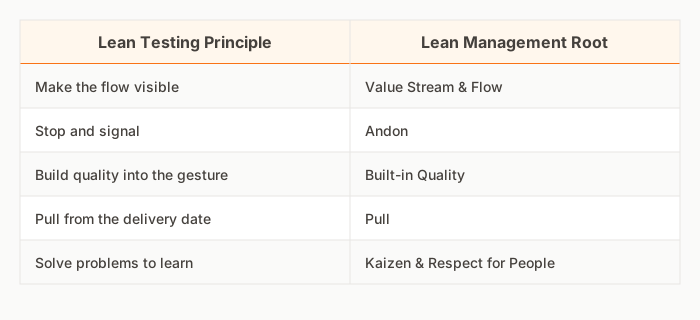
The value of these principles is that they translate Lean’s abstract concepts into concrete actions for software testing teams. “Flow” becomes a board with columns showing test cases in motion. “Jidoka” becomes a rule about calling for help. “Pull” becomes a daily target calculated from the deadline.
How Lean Testing Works
A team practicing Lean Testing works differently. Here’s how.
The Visual Board
A board dominates the workspace, physical or digital. Test cases move through columns: Backlog → Designed → Written → Executed → Done. Rows are organized by delivery date, not by tester. Daily targets are written at the top of each row. Colored markers show progress checkpoints: 11 AM, 3 PM, and the end of the day.
Red cards stand out. They signal blocked work. You’d also see a section tracking “invisible” work: support requests, urgent emails, and ad-hoc meetings. The team learned to make interruptions visible because that’s where time disappears.
The Daily Stand-up
At 9 AM, the team gathers at the board. Fifteen minutes, no more. Each person provides input, but most importantly, the team leader shares the day’s objectives and explains how they were calculated. He recalls the specific strategies to improve the daily performance. The conversation stays anchored to the board and the KPIs. When someone mentions a blocker, the team decides who will help, right there.
The Andon in Action
A tester stops typing. Something doesn’t look right. Instead of investigating alone, she places a red marker on her screen and calls the functional expert. He walks over, looks at the issue with her, and within five minutes, they’ve resolved it: the behavior was correct, just poorly documented. No false defect. No wasted hour.
The PDCA on the Wall
Near the board, a flipchart shows an ongoing investigation. Yesterday, the team hit only 2 tests against a target of 8. The chart breaks it down: problem statement, identified root causes (environment unavailable for 3 hours; two testers pulled into a meeting), proposed countermeasures, owner, deadline. By Friday, the team will know if the fix worked.
The Defect Report Standard
You notice a tester opening a defect in the tracking tool. The form won’t let her submit until three fields are filled: screenshot, steps to reproduce, and expected behavior with a spec reference. She pauses, checks the spec, and closes the form. The behavior was correct. No defect filed. The standard did its job silently.
Case Study: A Real Transformation
Here’s how these principles and practices come together. This story comes from a testing team responsible for validating billing scenarios for a telecom client. A separate case study covers an insurance testing team that achieved similar results.
The Starting Point
The team had 13 testers across two sites. Their job: validate invoice generation scenarios before production releases. The client was frustrated. Testing started too slowly at the beginning of each phase. Testers lacked autonomy. The same questions kept coming up.
The numbers told the story:
- Client satisfaction: 6 out of 10
- Productivity: 0.37 scenarios per person per day
- False defect rate: 15% of reported defects were abandoned due to diagnostic errors
Observations revealed deeper issues. Testers constantly asked colleagues for help. I observed seven requests in three hours. Some testers ran the same test repeatedly without reaching a conclusion. Others investigated for over two hours before escalating, without opening a defect ticket. The work was invisible, the problems hidden.
Making Work Visible
The team built a visual management board. Test scenarios flowed through columns: Backlog, Designed, Written, Executed, Done. Each row represented a delivery date. Progress was checked at 11 AM, 3 PM, and at the end of the day.
Critically, the board also tracked “contributions”: support requests, meetings, and interruptions from other projects. Testers made these visible using sticky notes. For the first time, everyone could see where the time actually went.
A Crisis Reveals the System
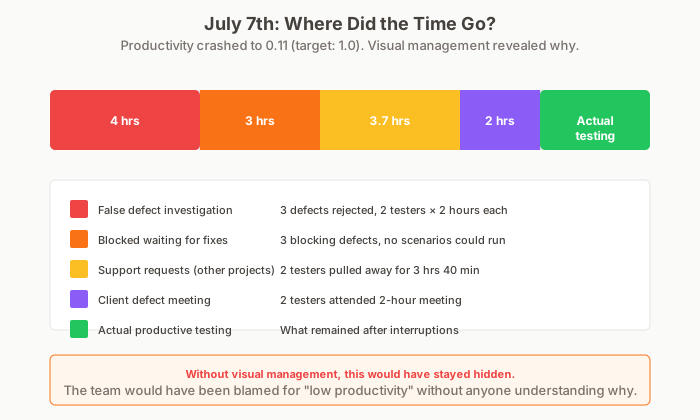
On July 7th, the visual board showed a disaster: productivity had crashed to 0.11 scenarios per person. The target was 1.0. Something was very wrong.
The team gathered around the board and traced through the day:
- Seven defects had been reported. Three were rejected as false defects. Two testers had spent two hours each investigating.
- Three blocking defects were awaiting fixes; no scenarios could be run while waiting.
- Two testers had spent 3 hours and 40 minutes on support requests from other projects.
- Two testers had attended a 2-hour defect meeting with the client.
The root cause was clear: invisible interruptions were consuming the team’s capacity. Without visual management, this would have remained hidden. The team would have been blamed for “low productivity” without anyone understanding why.
The Countermeasures
The team implemented four actions:
- Call the team leader immediately when blocked, rather than silently absorbing the delay
- Declare known support requests during the morning stand-up, so they can be planned
- Update the visual board in real-time as interruptions occur
- Each tester makes their contributions visible using sticky notes
Two days later, productivity was back to 0.92, close to the target. More importantly, the team discovered the reality of their workload. They found that support requests from other projects had consumed nearly four hours in a single day. This data gave the manager leverage to negotiate better boundaries.
The Results
After three months, the transformation was measurable:
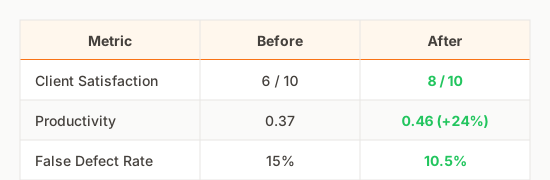
The client noticed the change: “I’m satisfied with the visibility on test progress.” The team had demonstrated a repeatable productivity peak of 0.7 scenarios per person per day, nearly double the starting point.
The false defect rate dropped from 15% to 10.5%, partly through better use of andon. Testers stopped guessing and started asking.
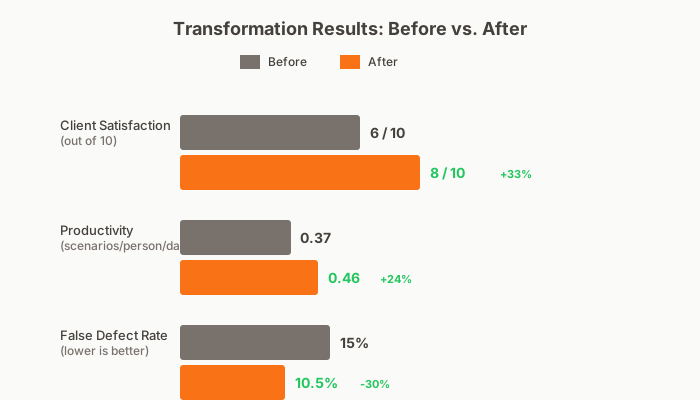
Beyond the numbers, the team had transformed. They could see their own work. They could identify problems, solve them, and had become autonomous.
Lean Testing and AI-Powered Testing
Teams often asked: with AI tools emerging for test generation, defect prediction, and automated analysis, is Lean Testing still relevant?
Yes. And they’re deeply connected.
The Common Ground
Both Lean Testing and AI-Powered Testing attack the same fundamental problem: testers spend too much time on low-value activities.
Writing repetitive test cases, hunting for false defects, re-executing known scenarios, and searching for root causes. These activities consume hours but add little value.
Lean Testing solves this through human systems: visual management to reveal waste, andon to prevent false defects, PDCA to find root causes, and standards to share best practices.
AI can accelerate all of these:
- AI can analyze test data to reveal patterns of waste
- AI can flag potential duplicate defects before they’re reported
- AI can pattern-match to suggest likely root causes before observation
- AI can prioritize tests by risk and business impact
- AI can learn from the best testers and encode their approaches
The Deeper Insight
Lean Testing prepares teams for AI adoption.
Teams that practice Lean Testing already track defects, blockers, and cycle times through visual management and PDCA. That data is clean and structured, ready to feed AI tools. They know what “good” looks like, so they can validate AI suggestions. They already question assumptions rather than blindly following procedures.
Teams that haven’t practiced Lean Testing will struggle with AI. They’ll automate their waste. They’ll accept AI suggestions without the judgment to evaluate them. They’ll lack the data AI needs to learn from.
Lean Testing was the manual way to do what AI can now accelerate, but without Lean thinking, AI just automates the waste.
Getting Started with Lean Testing
You don’t need to transform everything at once. Start small:
- Make one thing visible. Create a simple board showing test cases flowing toward a delivery date. Track progress at midday and the end of the day.
- Measure one problem. Pick your biggest pain point (false defects, failed retests, or missed deadlines) and measure it for two weeks.
- Run one PDCA. When you see a gap between target and actual, gather the team and investigate. Find the root cause, then try a countermeasure.
- Implement one andon. Establish a rule: when in doubt, call for help before reporting a defect.
These four steps will teach you more about Lean Testing than any book. You’ll see immediate results, and you’ll build the capability to go further.
What Lean Testing Actually Is
Lean Testing is not a methodology you install. It’s a way of thinking about work for better tester development.
Make the flow visible, stop and signal, build quality into the gesture, pull from the delivery date, and solve problems to learn.
Teams that embrace these principles test smarter and faster. They spend less time on waste and more time on value. They build capability instead of dependence.
And when AI tools arrive, they are ready.
Frequently Asked Questions
How quickly can teams expect results from Lean Testing?
Most teams see improved clarity within the first two weeks as visual management reveals previously hidden bottlenecks. Measurable results typically appear within three months. One team achieved a 200% increase in productivity and a 14% reduction in client-reported defects during that timeframe. The key is starting with small, focused improvements rather than attempting a complete transformation overnight.
Does Lean Testing require certification or specialized expertise?
No. The principles are accessible to any testing team willing to honestly observe their own work. That said, working with someone experienced in Lean Management accelerates the learning curve. The first teams I worked with had a Lean expert guiding them through the initial months. The real requirement is curiosity first; credentials come later.
Does Lean Testing work in Agile environments?
Yes. Lean principles complement Agile frameworks well. Both emphasize continuous improvement, visual management, and responding to change. Lean Testing adds rigor to sprint retrospectives with problem-solving and by tracking specific metrics that highlight improvement opportunities. Many teams find that Lean Testing provides the practical tools to achieve the quality goals Agile describes, but doesn’t always detail how to implement them.
What’s the biggest challenge when implementing Lean Testing?
The mindset shift. Managers must move from directing work to enabling problem-solving. They must resist solving problems for the team and instead coach testers to develop their own solutions. This requires patience and trust, especially when deadlines loom. The payoff comes when testers develop stronger analytical skills and take ownership of quality issues.
How is Lean Testing different from traditional test management?
Traditional test management focuses on planning, tracking, and reporting. Lean Testing focuses on learning, problem-solving, and developing testers’ autonomy. Instead of managing outputs, you build capability. Instead of hiding problems in status reports, you make them visible so the team can fix them. Testers evolve from executing scripts to investigating root causes and improving the process itself.
Can Lean Testing work with distributed or remote teams?
Yes, with adaptation. The visual board becomes digital. Stand-ups happen over video. The andon signal becomes a message or a flag in a shared tool. The principles remain the same: make work visible, surface problems fast, solve them together. One team in the case study had testers across two sites and still achieved significant improvements. The discipline matters more than the physical setup.
Get the Lean Testing Quick-Start Kit. 4 practices, real results, a two-week plan to start Monday.
Get the Kit →